Sci-Seedlets & Impact
Sci-Seedlets take onboard feedback and experiences from various public engagement initiatives. The Sci-Seedlets and StomaToy team has participated in several in-person science festivals and events and shared the resources internationally for enhanced plant science experiences.

Sci-Seedlets at Scottish Primary Schools 2025
Feedback data from Primary school pupils
Sci-Seedlets team worked with class teachers to trial our kits for plant science research.
We collected feedback before and after the activities event to gauge the impact on children’s understanding of plants and plant science.
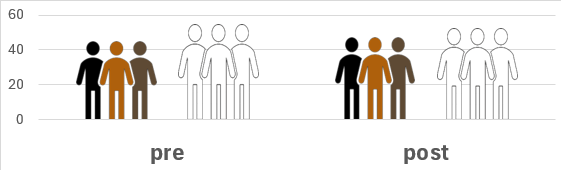
To measure the impact of the Sci-Seedlets activities, a questionnaire was given to the pupils (N=235). They were asked to respond to the questions to gauge their interest in plant science learning styles. The responses, pre and post-activity, were analysed and the results showed a statistically significant shift in positive responses post-activity.

What did I learn? What did I like?
“I learned that plants can’t grow in seawater.”
“I also enjoyed how we worked in groups”.
“Sea water doesn’t work as well as normal water.”
“Measuring the different seedlings.”
“Salt water is bad for the growth of plants.”
Sci-Seedlets at Scottish Primary Schools 2025
Feedback data from Primary school Teachers
Sci-Seedlets team worked with class teachers to trial our Leaf-Zoom and AMAiZING Maize kits for plant science research.
We collected feedback after the activities to gauge the impact of the kits on the pupils’ understanding of plants and plant science.
To measure the impact of the Sci-Seedlets activities, a questionnaire was given to the teachers (N=12). The responses were analysed and the results showed that the teachers’ felt there were a wide range of positive outcomes.

“My learners greatly enjoyed using the Sci-Seedlets kit. The teacher instruction book was clear and easy to follow. The lessons were well pitched, allowing learners who already had an interest in plant science to challenge themselves whilst still supporting learners who require additional support. The resources were engaging and clear for learners to use”. Primary Teacher, Glasgow
“The kids thoroughly enjoyed the lessons. The sessions were great and they wrote fantastic reports with all the information they gathered.’’ Primary Teacher, North Lanarkshire.
Sci-Seedlets at local Primary Schools 2024
Feedback data from P6 class
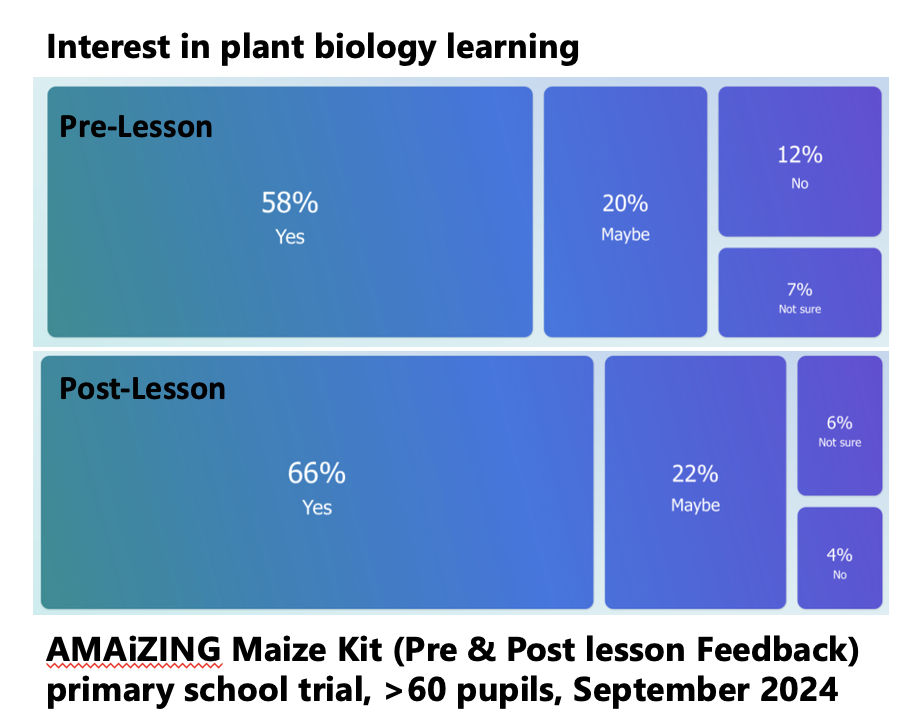
Sci-Seedlets team worked with class teachers to trial our AMAiZING MAIZE kit for plant science research and for concepts of stress comparison linked to climate change and pollution.
We collected feedback before and after the activities event to gauge the impact on children’s understanding of plants and plant science.
To measure the impact of the Sci-Seedlets activities, we administered a short questionnaire to the participants (N=60). The P6 class students were asked to respond to the questions to gauge their interest in plant science topics. The responses to the questionnaire, pre and post-activity, were analysed and the results showed a statistically significant shift in positive responses post-activity.
Sci-Seedlets at local Primary Schools, Glasgow 2021
Feedback data from P3 class
Sci-Seedlets team worked with class teachers to deliver educational experiences for plant science research and for concepts of plant growth and plant exchanges with the environment through stomatal pores.
We collected feedback before and after the activities event to gauge the impact on children’s understanding of plants and plant science.
To measure the impact of the Sci-Seedlets activities, we administered a short questionnaire to the participants (N=45). The P3 class students were asked to respond to the questions with options to answer Yes/No to gauge their interest related to plant science topics. The responses to the questionnaire, pre and post-activity, were analysed using the McNemar test. The results showed a statistically significant shift in positive responses post-activity (p<0.05 for all questions).


Spreading the StomaToy fun
We shared the StomaToy resources internationally with scientists for use in their own public events. The feedback we collected demonstrated the potential of the resources to engage a diverse audience.
“Thanks again for sharing the leaf cube – it helped a lot in explaining plant water transport (and for the advanced visitors, photosynthesis as well). The kids and parents liked it a lot – in particular in combination with a leaf epidermis strip (under a microscope) in to see plant stomata”. Dr Katharina Bürstenbinder, Leibniz-Institute of Plant Biochemistry, Germany
The Science inspiring Sci-seedlets
Humans rely on plants for almost every aspect of our life, including obtaining oxygen, food, fuel, clothing and shelter. Yet, plant science is often not seen as relevant to modern life and plant science research is still perceived as a ‘dry’ subject over medicine. In present times, our world is challenged by global warming and climate change. Plants are at the centre of mitigating the climate crisis and to overcome severe shortages in food, agricultural land and water resources imminent within the next 1-2 decades. For a sustainable future, plant science research to understand how plants grow and respond to their environment is fundamentally important. This work is also essential for informing crop enhancements and predicting behaviours of plants in withstanding climate change.
In the plant science group at the University of Glasgow, Karnik and Blatt labs study how plants grow and respond to endogenous and environmental cues, such as hormones, pathogens and CO2, carry out mathematical modelling of plant behaviours and test how molecular components in plants can be manipulated to enhance plant growth efficiencies. This work is reflected in the discovery of new molecular mechanisms for plant stomatal responses, growth and immunity detailed in several publications in highest impact journals in the field.
Publications:
- Baena G, Xia L, Waghmare S, Karnik R. (2022) SNARE SYP132 Mediates Divergent Trafficking Of H+-ATPase AHA1 And Antimicrobial PR1 During Bacterial Pathogenesis. Plant Physiology (March 2022).
- Jezek, M., Silva-Alvim, F.A.L., Hills, A., Donald, N., Ishka, M.R., Shadbolt, J., He, B., Lawson, T., Harper, J.F., Wang, Y., Lew, V.L., And Blatt, M.R. (2021). Guard Cell Endomembrane Ca(2+)-ATPases Underpin A ‘Carbon Memory’ Of Photosynthetic Assimilation That Impacts On Water-Use Efficiency. Nature Plants 7, 1301-1313.
- Klejchova, M., Silva-Alvim, F.A.L., Blatt, M.R., And Alvim, J.C. (2021). Membrane Voltage As A Dynamic Platform For Spatiotemporal Signaling, Physiological, And Developmental Regulation. Plant Physiology 185, 1523-1541.
- Zhang B, Xia L, Zhang Y, Wang H, Karnik R. Tri-SUS: A Yeast Split-Ubiquitin Assay To Examine Protein Interactions Governed By A Third Binding Partner. Plant Physiology 2021;185(2):285-9.
- Xia L, Mar Marques-Bueno M, Karnik R. Trafficking SNARE SYP132 Partakes In Auxin-Associated Root Growth. Plant Physiology 2020;182(4):1836-40.
- Xia L, Mar Marques-Bueno M, Bruce CG, Karnik R. Unusual Roles Of Secretory SNARE SYP132 In Plasma Membrane H+-ATPase Traffic And Vegetative Plant Growth. Plant Physiology 2019;180(2):837-58.
- Papanatsiou, M., Petersen, J., Henderson, L., Wang, Y., Christie, J.M., And Blatt, M.R. (2019). Optogenetic Manipulation Of Stomatal Kinetics Improves Carbon Assimilation, Water Use, And Growth. Science 363, 1456-1459.